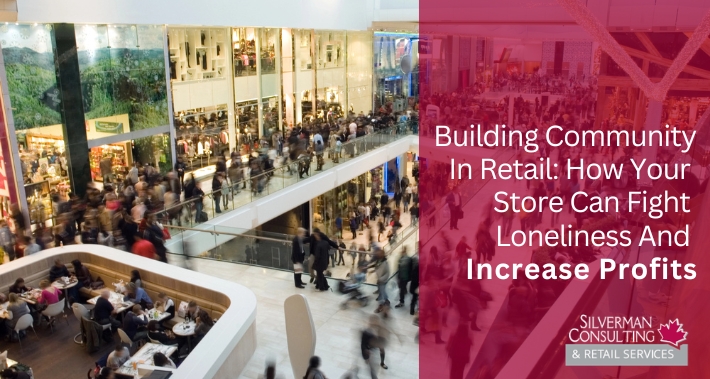
Loneliness has quietly become one of the biggest challenges facing our communities today.
What used to happen naturally in town squares, local shops, and shared gathering spaces now happens far less often — and many people feel the impact.
While digital convenience has made shopping easier, it has also reduced meaningful, face-to-face interaction.
But here’s the opportunity: retail stores are uniquely positioned to help fill that gap.
When designed intentionally, your store can become more than a place to transact — it can become a place to connect.
At Silverman Consulting and Retail Services, we work with retailers to strengthen profitability while building stronger customer relationships.
We’ve seen firsthand how community-driven strategies can increase loyalty, repeat visits, and long-term value.
In this article, we’ll explore what the loneliness epidemic is, why it’s growing, and how your retail store can play a powerful role in bringing people together — while strengthening your business at the same time.
What Is The Loneliness Epidemic?
The loneliness epidemic is the widespread decline in people making meaningful connections and feeling increasingly isolated.
This issue has become so prevalent that it has been declared a public health crisis.
Loneliness is a state of mind that can make people feel isolated, empty, and undesired.
People with loneliness often feel alone internally even if they are not physically alone.
Left untreated it can be dangerous and lead to significant mental and physical health consequences.
There are numerous reasons why someone may feel lonely, however loneliness is typically associated with:
- Social isolation
- Poor social skills
- Introversion
- Depression
Keep in mind that loneliness and solitude are not the same thing.
People with loneliness feel isolated but want to have social connections.
It’s perceived as something involuntary, a form of rejection or abandonment.
On the other hand, solitude is voluntary.
People choose to withdraw themselves and spend time alone while still maintaining good social relationships that they can return to when they feel the need.
Why Are People So Lonely?
Everyone experiences loneliness differently and for different reasons.
Some factors that may contribute to loneliness can include:
- Physical isolation
- Relocation
- Divorce
- Grief
- Psychological disorders
- Low self-esteem
- Personality factors
The modern social and technological landscape is also contributing to the rise of loneliness.
Despite having the tools to connect more than ever, people are becoming more and more isolated.
Social media platforms provide a sort of fake intimacy that uses algorithms to peak interest and get rid of boredom.
However, this distraction takes away meaning and purpose, leading to further disconnect from other people.
The rise of digital marketplaces also plays a factor, no longer requiring customers to leave their homes or have interactions.
The good news is that as a retail store owner you have the potential to address this growing issue while driving your store’s business.
You can position your retail store to help people connect and have meaningful interactions over a shared interest.
Not only can this increase customer loyalty and purchases, but it can also improve their health and overall well-being.
What Are the Consequences Of Loneliness?
There are numerous negative effects that you may experience due to loneliness.
These consequences can impact both your physical and mental health.
Potential health risks associated with loneliness can include:
- Altered brain function
- Progression of degenerative disease
- Alcohol and substance misuse
- Depression
- Suicidal intentions
- Antisocial behaviour
- Cardiovascular disease
- Stroke
- Decreased memory and learning
- Challenges with decision making
- Increased levels of stress
- Reduction in physical activity
- Weight gain
- Sleep difficulties
- Chronic fatigue
- Premature aging
Overcoming loneliness requires a conscious effort in order to make a change so that you can live a happier, healthier life.
Getting more involved and feeling that you’re part of something can help build a sense of community so that you can begin to interact and connect with others.
Your retail store can help by creating a space where people can feel seen, known, and included.

How Can Your Retail Store Help The Loneliness Epidemic?
Retail stores have a unique and powerful potential to help with the loneliness epidemic.
You can position your retail store as a place of comfort and recreation that provides more genuine human interactions.
The idea is to encourage people to come and stay without feeling rushed to shop right away.
You can design your store’s layout to provide customers the opportunity to sit together and socialize.
When it comes to your staff, it’s important to train them not just to sell, but to connect with customers as well.
Promoting this form of communication increases engagement and can help your customers feel acknowledged and included.
Establishing a community focus and encouraging authentic interactions in your retail store can increase customer loyalty and employee satisfaction.
In this way, your retail store becomes a space of participation, not just a business focused on transactions.
Ultimately this can benefit your business by:
- Increasing customer lifetime value
- Reducing employee turnover
- Increasing repeat visit frequency
- Increasing average transaction value
To ensure your staff is adopting this customer centric focus and connecting with them meaningfully, you can:
- Provide regular positive feedback
- Conduct peer role-play
- Celebrate progress, even small achievements
Keep in mind that technology can still be beneficial.
Social media and other digital tools can still be used to build your store’s identity and keep customers connected on upcoming events, further building that sense of belonging people want.
Organizing and hosting small social events at your store can become shared experiences among your customers and staff.
Additionally, CRM systems and loyalty programs can help provide a personal touch to your customers that makes them feel valued.
By strategically positioning your retail store as a community-building space you can:
- Increase revenue
- Decrease costs
- Create a competitive advantage to digital retailers
- Help combat the loneliness epidemic
Book Your Consultation With Silverman Consulting and Retail Services Today
Loneliness may be one of the defining challenges of our time — but it also presents a powerful opportunity for retailers willing to think beyond transactions.
By intentionally designing your store as a space for connection, conversation, and shared experience, you can strengthen both your community and your bottom line.
A community-centered retail strategy builds loyalty, increases repeat visits, and creates a competitive edge that online-only retailers simply can’t replicate.
At Silverman Consulting and Retail Services, we help retailers turn these ideas into practical, profitable action plans tailored to their unique markets.
Whether you’re looking to reposition your store for long-term growth or preparing for a successful closing sale and transition, we’re here to guide you every step of the way.
Book your consultation with Silverman Consulting and Retail Services today and let’s build a strategy that strengthens your business while bringing people together.
Silverman Consulting & Retail Services229 Yonge St suite 400,
Toronto, ON M5B 1N9, Canada
1 (888) 955-1069