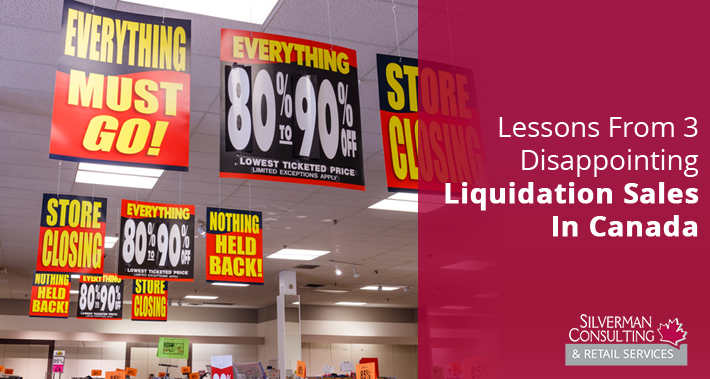
Are you thinking about closing up shop and getting out of the retail world to move on to the next stage of your life?
If this is the case, it’s important to have an exit strategy.
At Silverman Consulting And Retail Services, you can trust us to help you manage your store closing event as well as liquidating your assets.
We want to work with you to move your product with a successful liquidation sale and free up your capital for your next stage of life.
Now, there are a lot of different ways of going about liquidating your assets but not all of them are successful.
As a small business owner, you might think you’re at a disadvantage compared with some of the big box stores.
But that’s not necessarily true.
Today, let’s take a look at three of the most disappointing liquidation sales in Canada over the last decade or so, and the valuable lessons these obvious liquidation sale blunders give us.
Let’s start with the most recent one.
What Happened With Nordstrom Canada’s Disappointing Liquidation Sale?
Nordstrom Canada Retail, the Canadian division of Nordstrom, was announced on September 13, 2012.
As a luxury department store, Nordstrom competed in the market against other Canadian department stores.
Since Nordstrom entered the Canadian market, it built six full line stores and seven Nordstrom Rack locations.
However, on March 2, 2023, Nordstrom announced that they would be closing down all of their Canadian stores.
At the beginning Nordstrom’s liquidation sale didn’t sit well with the public.
The public expected that the company would have large clearance sales and that they could snag some sweet deals.
But when the sales did finally roll out they appeared to be insignificant and some consumers took offence.
Lessons Learned
You must look at the store, the merchandise, and the situation.
Nordstroms was never a discounter at their main locations.
When they did have sales with end of season and excess inventory, they moved that through their Nordstrom Rack locations.
These were better known for more value.
Much of the merchandise, especially designer and luxury brands were never discounted, so starting at 5% and moving to 10% was significant for some brands.
This was not a store led liquidation, it’s important to note.
They had a court approved liquidation under a section of the bankruptcy act, and this complicates the process and cost of the liquidation.
That said, Nordstrom’s liquidation set expectations of deep discounting.
This disappointed many shoppers at the start of the sale which likely reduced initial traffic.
As the sale proceeded the prices continue to drop, but again they were misleading.
Ads told of discounts of 30% to 50% off, but when customers arrived, they found little if any items at the 50% off level.
If you continue to disappoint shoppers, the traffic will also drop.
The general public who may not have been a Nordstrom customer will likely be more disappointed than regular Nordstrom customers.
Their regulars would have known the value of their luxury lines and would have been satisfied with 10% or 20% off items that seldom went on sale.
I noticed that when the price dropped from 10% to 20% on cosmetics and fragrances, all the top brands and scents were already gone.
Nordstrom Rack may have better deals as a fair amount of their product was already discounted, and the liquidators were applying the discounts to the already reduced prices.
If you are overstocked be conscious of how you market your sale to move as much of your product as you can to free up capital before moving on.
It’s not about giving your product away, but recognizing that your days of maximizing retail margins are behind you.
What Happened With Target Canada’s Disappointing Liquidation Sale?
Another big retailer that withdrew from Canadian markets was Target Canada, which opened its first store in March 2013.
Overly aggressive in its expansion in Canada and with higher prices than other rivals, it racked up $2.1 billion in losses.
Target Canada finally shut down all of their 133 stores by April 12, 2015.
After announcing that they were unable to meet their employee’s payroll in January 2015, liquidation sales began the following day.
Having announced huge sales of up to 30% customers were excited at the opportunity to snag discounted products.
However, some markdowns were misleading and prices were still comparable to other competitors.
Lessons Learned
Like Nordstrom, shoppers were hoping to get some big deals in Target’s liquidation sale but were left disappointed.
Target Canada had big store signs and ads that promised 30% off.
And then, in small print, it said “up to.”
When the public see the 30% off, they expect to see a significant amount of the inventory at the 30% off level.
But when shoppers went to take advantage of their store closing sales event, they found most items were only 10% discounted, with only a few at 20%.
Some Apple electronics, which seldomly are on sale, only had a 5% markdown.
Most customers were disappointed and felt misled.
Retail researchers said they weren’t surprised by the small markdowns in sales.
Target needed to clear out merchandise and pay off debts.
However, customers were leaving disappointed and were unlikely to return even if there were larger upcoming sales.
Some were even saying that other competitors’ standard prices were still more affordable than the discounted products at Target.
So what’s the lesson here?
Your advertising should never be misleading to potential customers.
If you have multiple discount levels, clearly print the lowest along with the top discount.
As well, make sure there is significant inventory in each category.
Most customers won’t return after being sold on false promises and it may decrease your ability to move products.
Target was clearly not too concerned about their reputation in Canada, but if you’re a small business owner, you’ve built your livelihood on that reputation.
There’s no reason to scuttle that on a strategy that won’t work in the first place.
Sure, it may get more people through your door on day 1, but what does it matter if they don’t actually buy anything, and don’t come back?
What Happened With Sears Canada?
Sears Canada also received a lot of backlash for their liquidation sales after deciding to close their doors.
After years of falling sales and sliding market shares, Sears had announced plans to close all of its operations in Canada.
Its final and remaining stores were scheduled to close on January 14, 2018.
Although not using the terms of “bankruptcy”, “going out of business sale”, or “liquidation”, there were promises of major sales.
Regardless, customers found that Sears had higher prices than other competitors, limited inventory, and disorganized stores.

Lessons Learned
You wouldn’t pay for something that’s on sale if it’s still more expensive than at other retailers, right?
Of course not.
But that’s exactly what happened with Sears’ liquidation sale.
With their prices just marginally lower, competitors were able to compete with those prices to draw in shoppers.
Sure, when you close down your business you need to try and recover as much as possible as well as cover the operating costs.
But you have to understand the market and your customers.
Products should be offered with every incentive for customers want to come in and buy them today.
Not managing expectations and lack of market research can leave you racked up with inventory.
How to Avoid Disappointing Your Customers
In these examples the companies were eventually able to clear out the inventories, but at what costs?
Disappointing customers is never a good start.
Gauging and managing expectations is the challenge in all exit strategies.
And you only have one chance to make a good first impression.
These “liquidation events” spend a lot on marketing to get the people through the door.
But if you don’t have what people expect, you’ll need to spend even more on marketing to get them back.
The focus during closure should remain on the actual liquidation of inventory and assets rather than margins.
Understanding the competitive market climate is essential in determining the extent and success of your liquidation sales.
Employing successful and effective advertising strategies will draw customers into your stores before they go to your competitors.
Retail stores are absolutely still relevant, but don’t kid yourself.
Plenty of independent retailers are planning on closing, and the ones sticking around must be highly competitive.
One off the toughest things for retailers to understand on the first day of your closing sale is your inventory is not worth what it says in the books, but what customers will pay for it today.
Not properly managing your business closure and liquidation of assets can leave you with hundreds of thousands of dollars tied up in inventory and equipment.
Taking too long to sell it off will be costly too.
Don’t worry if this all sounds overwhelming because at Silverman Consulting we’re here to help you through the process.
Contact Silverman Consulting And Retail Services Today
Closing down your business is a big decision that needs a lot of management, attention, and insight.
As you’ve seen there are many details and strategies that you need to consider when it’s time to close the doors to your business.
If you’re ready for your next move in your life or career we’re here to help you make that transition.
We can help you plan and execute your store closing sale successfully and avoid the pitfalls.
Contact Silverman Consulting And Retail Services today, and we’ll work with you to manage your store closing event and liquidation of assets.
Silverman Consulting & Retail Services229 Yonge St suite 400,
Toronto, ON M5B 1N9, Canada
1 (888) 955-1069