Back in 2022, we wrote about how Canadian shoppers were starting to pull back on spending.
Inflation was climbing, interest rates were rising, and many people were still feeling the sting of the COVID-19 pandemic.
The mood was gloomy, and retailers were bracing for a tough road ahead.
But that was back in 2023.
So, where do things stand today?
As store closing sale consultants, we’re as busy as ever.
But does that mean a bad outlook on the retail world?
The short answer is: it’s complicated.
Canadians are still spending, but they’re spending differently.
New pressures and anxieties have replaced the old ones.
New habits have taken hold.
As a result, the retail landscape has changed in ways that would have been hard to predict back in late 2022.
Today, we’d like to revisit that old article.
However, we’ll do our best to keep this a self-contained article.
Let’s take a look at what’s happened since 2022, and what it means for your retail store right now.
What’s Changed Since 2022?
Back in 2022, the big worries were inflation and rising interest rates.
Canadians were paying more for groceries, gas, and rent, and the Bank of Canada was raising interest rates to try to slow things down.
On top of that, we were reeling from COVID-19 and the devastation it brought.
Shoppers were nervous, and that nervousness showed up at the cash register.
What about today?
As of March 2026, the Consumer Price Index has increased by 2.4%.
That means the cost of living increased by 2.4% on average.
Compare that with 2022, where the Consumer Price Index rose 6.8%.
That’s a big drop, and it’s good news.
Prices stopped rising as fast.
Gasoline prices actually fell 8.6% after the carbon tax was removed.
For many families, that was a real relief.
Since then, of course, gasoline has shot back up to historic highs.
But here’s the catch: just because inflation slowed down doesn’t mean prices went back to where they were.
Groceries, rent, and everyday costs are still high.
Grocery prices climbed 3.5% in 2025, on top of years of increases before that.
Many Canadians still feel squeezed, even if the rate of squeezing has slowed.
Interest rate cuts from the Bank of Canada have also started to help.
Recent interest rate cuts are beginning to feed through the economy and are likely to support activity gradually over 2026.
This is welcome news for homeowners with variable mortgages and anyone carrying debt.
But the benefits take time to be felt, and many households are still recovering from years of high borrowing costs.
A New Set of Worries
In 2022, the main concerns for Canadian shoppers were inflation, rising interest rates, and the lingering shadow of the pandemic.
Today, those worries have been joined by a whole new set.
Trade tensions with the United States have become a major source of anxiety.
As Canada enters 2026, economic confidence remains in negative territory, with consumers still feeling anxious over high prices and economic uncertainty from ongoing trade friction with the U.S.
In March 2025, Canada imposed 25% counter-tariffs on the United States.
That included grocery products, appliances, electronics, furniture, and household items.
These tariffs were eventually lifted, but the experience left many Canadians feeling uneasy about future price increases.
As a result, shoppers have changed their behaviour in a very real way.
Between half and two-thirds of Canadians say they always or sometimes avoid buying U.S. products or services, depending on the category.
This is a big shift.
Canadians are now actively looking for homegrown alternatives.
That’s something local retailers can actually use to their advantage.
Consumers have continued to substitute toward goods made in Canada and vacations within the country.
If your store stocks Canadian-made products, now is a great time to highlight that fact.
And if it doesn’t, now is a great time to change that.
How Are Canadians Actually Spending?
Despite all the uncertainty, Canadians have not stopped spending.
The picture is just more complicated than it used to be.
Retail sales in Canada are estimated to have increased by 0.9% in February of 2026.
This would mark a third consecutive month of gains.
That’s a sign that things are moving in the right direction, even if slowly.
If we exclude automotive, food, and pharmacies, retail store sales in January 2026 rose 5.6% year-over-year across the board.
This signals that core, non-essential spending is still growing.
In other words, Canadians are still buying things they don’t strictly need; they’re just being more careful about it.
But here’s something important: not all Canadians are spending the same way.
The “K-shaped” economy defined 2025.
That’s almost like a two-tiered economy, depending on how affluent you are.
It dictates which products, retailers, and services are doing well versus which are struggling.
What does that mean in plain language?
Higher-income shoppers are still spending fairly well, while lower- and middle-income households are watching every dollar.
Shoppers are deliberate, informed, and increasingly willing to trade loyalty for savings.
In one of the most striking changes from a few years ago, about 40% of consumers say they would buy whatever brand is on sale.
Brand loyalty, already shaky in 2022, has weakened further.
Canadians are monitoring basket costs, leveraging their loyalty points, and shopping across multiple retailers to maximize value.
The Online vs. In-Store Balance
Back in 2022, we noted that more Canadians were planning to shop in-store for the holidays.
That was a nice hopeful sign after the pandemic years.
That trend has continued, but with a twist.
Online shopping is as popular as ever, of course.
But Canadians still buy most things in stores.
According to Deloitte, Canadians are using the internet in different ways than just purchasing.
In particular, they’re using it to research a product before they buy it.
But 82% of customers want to be able to see and feel a product before they buy it.
That’s good news for brick-and-mortar retailers.
Shoppers haven’t abandoned physical stores.
But the bar for what makes a store visit worthwhile has gone up significantly.
Amazon expanded its same-day and overnight delivery faster across major regions in Ontario and British Columbia in 2024 and 2025.
That means many customers can now get items within hours, often at no extra cost if they spend over $25.
This changes how Canadians think about convenience.
If delivery can be almost instant, visiting a store must offer something more valuable than speed.
This is a challenge that every independent retailer needs to think hard about.
Your store cannot compete with Amazon on speed or price.
What it can compete on is experience, expertise, and human connection.
These are things that no algorithm can fully replace.
What does that look like?
Finding the right employees for your store.
Carrying the products people are actually looking for, rather than what you think they should have.
Building a sense of community in your store’s culture.
Making eye-catching displays to draw customers in.
In short, everything you’re probably already doing.
RELATED ARTICLE: How to Establish Trust in Your Retail Store
What Do Shoppers Want Right Now?
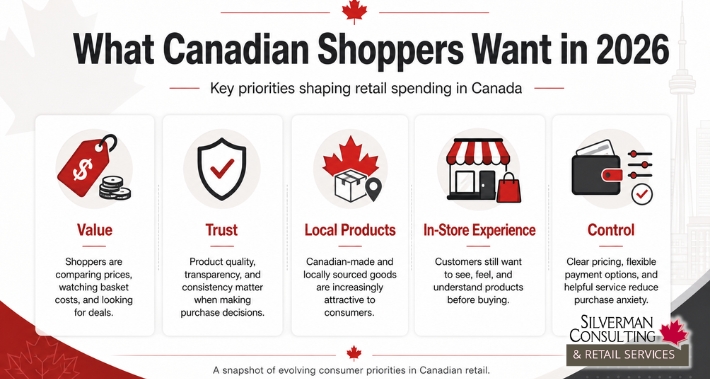
The values driving Canadian shoppers in 2026 are a bit different from those in 2022.
Back then, the main goal was to find deals and stretch budgets.
That’s still true, but there are new layers on top of it.
Canadians enter 2026 with cautious optimism, balancing improved financial sentiment with lingering uncertainty.
Intentional, value-driven spending dominates, as shoppers prioritize essentials and trade loyalty for savings.
Trust and transparency shape purchase decisions, with health, wellness, and locally sourced products gaining traction.
The vast majority of consumers say brand trust is very or somewhat important, with product quality and consistency as the top drivers.
This means that while shoppers are chasing value, they still care deeply about whether they can trust what they’re buying.
That’s an opening for small retailers who can genuinely stand behind their products.
Many Canadians also worry about how trade tensions and tariffs might affect prices and jobs.
According to a Bank of Canada survey from October 2025, many Canadians are putting off major purchases because they expect prices to rise.
This suggests that the fear of future price increases is already driving behaviour, even though those increases haven’t fully materialized yet.
What Can Retailers Do?
In our 2022 article, we offered four key pieces of advice: connect with your customers, resist the urge to discount everything, make gentle suggestions, and focus on customer happiness.
That advice still holds.
But in 2026, there are a few new things worth adding.
1. Lean into Being Canadian
The desire to buy local has never been stronger.
Consumers are increasingly substituting toward goods made in Canada.
If your store carries Canadian-made products, say so loudly and clearly.
Put it on your signage, your website, and your social media.
Many shoppers are actively looking for reasons to choose you over a big American retailer.
It’s also worth looking at the product lines you carry and considering whether there are any made-in-Canada alternatives.
2. Know Your Customer Tier
As we’ve seen, the K-shaped economy has split shoppers into two very different groups.
Think about who your core customer is.
Are they more likely to be budget-conscious, looking for value and deals?
Or are they in a position to spend on quality and experience?
Higher-income consumers have continued to spend but remain quite cautious.
As a result, some have started “trading down” in some areas, including groceries.
Even your more affluent customers may be looking for reassurance that they’re spending wisely.
3. Make Trust a Selling Point
For many shoppers, “value” now means trust, transparency, and alignment with personal priorities.
This is where small retailers have a real edge over big-box stores and online giants.
You can look your customers in the eye.
You can stand behind what you sell.
You can answer questions and offer real, human advice.
That matters more than ever right now.
4. Think about the “Why” of Your Store
As we mentioned earlier, while most shopping journeys begin online, more than 80% of purchases still happen in person.
So, people still want to go to a store.
The choice, then, is which store to go to.
Why should customers come to your store?
Is it your knowledgeable staff?
Your carefully chosen products?
Your welcoming atmosphere?
Whatever it is, double down on it.
Make it the thing your store is known for.
5. Help Customers Feel in Control
Consumer confidence remains low, and many Canadians are delaying major purchases and focusing on essential items.
There isn’t much you can do about broader economic trends.
But there are still some ways you can help ease that anxiety.
First off, be clear about your pricing.
Customers don’t want sticker shock when they arrive at your point of sale.
RELATED ARTICLE: How to Choose the Right POS System for Your Retail Store
Wherever possible, offer flexible payment options.
And make sure your staff are trained to be helpful rather than pushy.
A customer who feels good about a decision is far more likely to come back.
The Road Ahead
The Canadian retail environment in 2026 is not the same as it was in 2022.
However, many of the underlying challenges remain.
Shoppers are still cautious.
They’re still hunting for value.
They’re still uncertain about the future.
Together with the drags from weak population growth and trade-related headwinds, the economy is expected to grow at a below-trend pace this year.
But there are genuine reasons for optimism too.
Retail sales posted three consecutive months of gains heading into spring 2026.
Interest rate cuts are starting to put more money in people’s pockets.
And the strong desire among Canadians to buy local is creating real opportunities for independent retailers who are willing to make that part of their identity.
The retailers who will thrive are the ones who stay close to their customers, remain honest about value, and keep finding new reasons to make a store visit feel worthwhile.
That was true in 2022, and it’s just as true today.
Book Your Consultation with Silverman Consulting Today
The Canadian retail landscape may look different than it did a few years ago, but one thing remains the same: retailers who understand their customers and adapt to changing conditions are the ones most likely to succeed.
While inflation, trade uncertainty, and shifting consumer habits continue to influence spending decisions, there are still meaningful opportunities for businesses that focus on trust, value, community, and a strong in-store experience.
By staying connected to your customers and highlighting what makes your store unique, you can continue to thrive even in a cautious economy.
At Silverman Consulting and Retail Services, we help retailers navigate both growth opportunities and major transitions with confidence.
Whether you’re looking to strengthen your business or planning your exit from retail, our team has the experience to help you achieve the best possible outcome.
Book your consultation with Silverman Consulting and Retail Services today and let us help you position your business for success — whatever the future holds.
Silverman Consulting & Retail Services229 Yonge St suite 400,
Toronto, ON M5B 1N9, Canada
1 (888) 955-1069