Learning how to start a retail business is an exciting first step toward becoming your own boss.
Whether you’ve always dreamed of opening a boutique, specialty shop, or another type of retail store, turning that vision into a successful business takes much more than a great idea.
It requires careful planning, market research, and a clear strategy from day one.
At Silverman Consulting and Retail Services, we’ve worked with retailers through every stage of the business lifecycle.
While we’re best known for helping business owners maximize value through store closing sales and liquidation events, we’ve also seen firsthand what separates successful retail businesses from those that struggle.
Those lessons provide valuable insight for entrepreneurs who are just getting started.
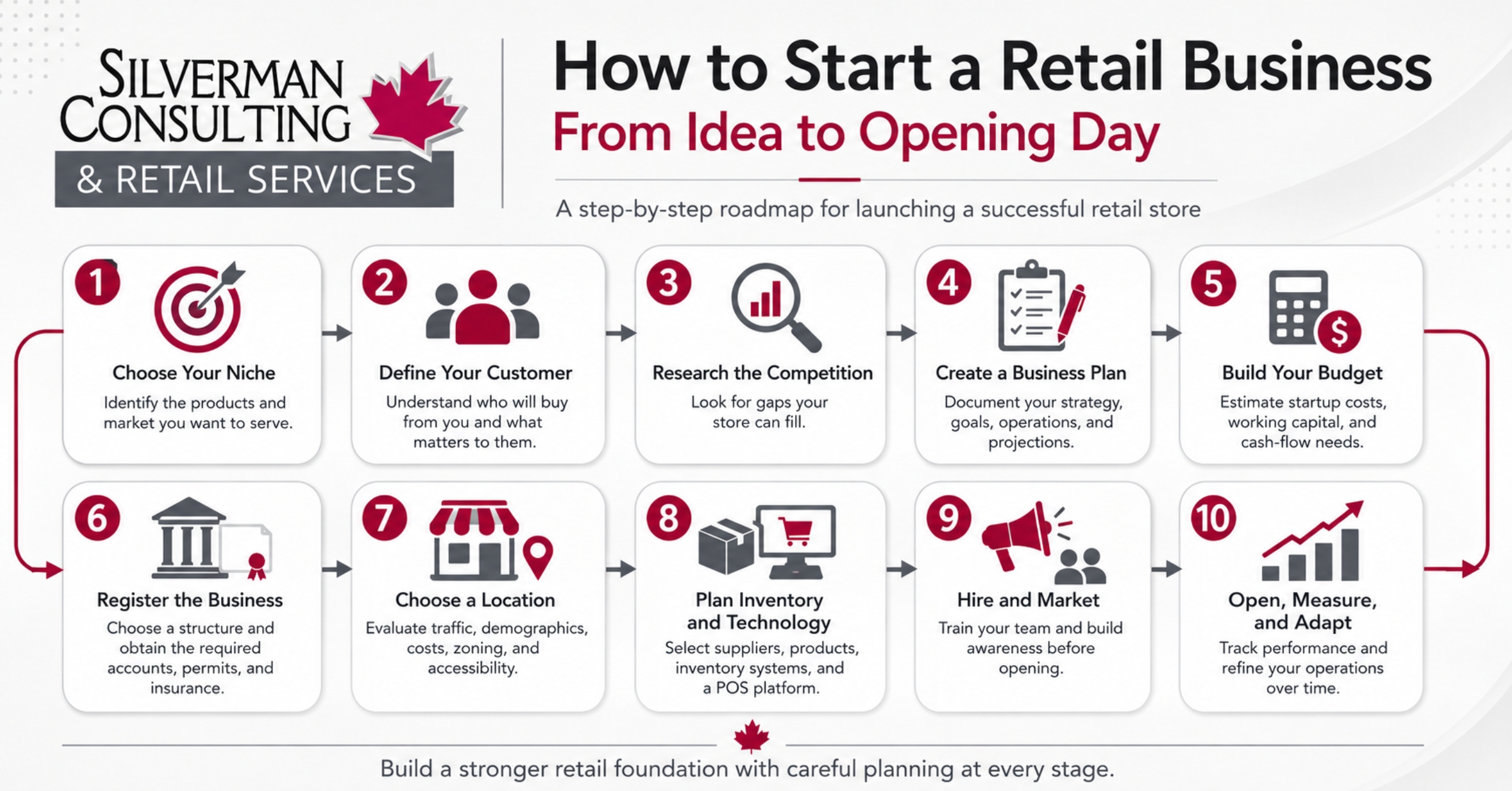
In this step-by-step guide, we’ll walk you through the key stages of starting a retail business, from choosing the right niche and creating a business plan to selecting a location, managing inventory, and preparing to open your doors.
Choose the Right Retail Niche
If you’ve already made the decision to open your own business, you’ve probably also thought about what kind of products you want to offer.
But how specific can you get about your customers and the type of products you’d like to offer them?
It’s worth taking some time to choose the right niche before you commit to inventory, sign a lease, or build your brand.
A good retail niche usually sits at the intersection of customer demand, your own knowledge or interests, and a business model that can realistically make money.
Ask yourself:
- Who is most likely to buy these products?
- What need, problem, or interest will my store address?
- How often are customers likely to make a purchase?
- What profit margins may be possible after product, shipping, labour, and operating costs?
- Can I source the products reliably?
- How crowded is the local and online market?
Depending on your experience and local market, you might research options such as:
- Sporting goods shops
- Specialty grocery stores
- Gift shops
- Hardware stores
- Clothing boutiques
- Furniture and home decor stores
- Footwear stores
- Bike shops
- Bookstores
Each of these can work in the right market.
However, no type of retail business is automatically profitable.
Instead of choosing a niche based on a broad trend alone, look closely at the customers, competition, costs, and demand in the specific market you plan to serve.
Define Your Target Customer and Test Demand
Trying to sell to everyone can make it difficult to decide what to stock, how to price it, where to open, and how to market your store.
That’s why your next step is to define your target customer.
Consider factors such as:
- Age and life stage
- Location
- Income and spending habits
- Interests and priorities
- The problem they want your products to solve
- Where and how they currently shop
- What matters most to them, such as price, quality, convenience, expertise, or exclusivity
Then, test whether the demand you expect is actually there.
Good market research can include speaking with potential customers, reviewing available industry and demographic data, visiting competing stores, studying online reviews, and testing your concept through a pop-up, small initial product selection, or online store.
The more you learn before making major financial commitments, the easier it will be to adjust your idea while changes are still relatively inexpensive.
Get to Know Your Competitors
Once you have chosen a niche and found early signs of demand, it’s time to research your competition.
Your competitors may include nearby stores, major chains, online retailers, marketplaces, and other businesses that solve the same customer problem in a different way.
Pay close attention to:
- The specific products and brands they offer
- The products or services they don’t offer
- Their pricing and promotional strategy
- How they handle merchandising and remerchandising
- The customer experience they provide
- Their website, social media, and online reviews
- The types of sales events they run
- Their location and how it contributes to their success
The goal isn’t to copy another retailer.
It’s to understand what customers already have available and identify where your store can offer something more useful, convenient, specialized, or memorable.
Create a Business Plan
After all your brainstorming and research, it’s time to put your idea on paper in the form of a business plan.
A business plan can help you clarify how your store will operate, identify potential weaknesses, set measurable goals, and explain your concept to potential lenders or investors.
Your plan should generally include:
- An overview of your business and retail concept
- Your short- and long-term goals
- Your target market and evidence of demand
- Your unique selling proposition
- An overview of your competitors
- Your products, suppliers, and inventory strategy
- Your pricing, sales, and marketing strategy
- Your planned location and sales channels
- The legal and management structure of the business
- The employees you expect to need
- Your startup costs and funding requirements
- Your estimated sales, expenses, cash flow, and break-even point
If you need help organizing these details, the Government of Canada provides a business plan guide and links to planning resources.
Going through this process can be surprising, since it may reveal just how expensive opening and operating your store could be.
However, it’s important to understand what you’re getting into with both eyes open.
Create a Realistic Startup Budget
Your business plan explains how the store will work.
Your startup budget shows what it will cost to make that plan a reality.
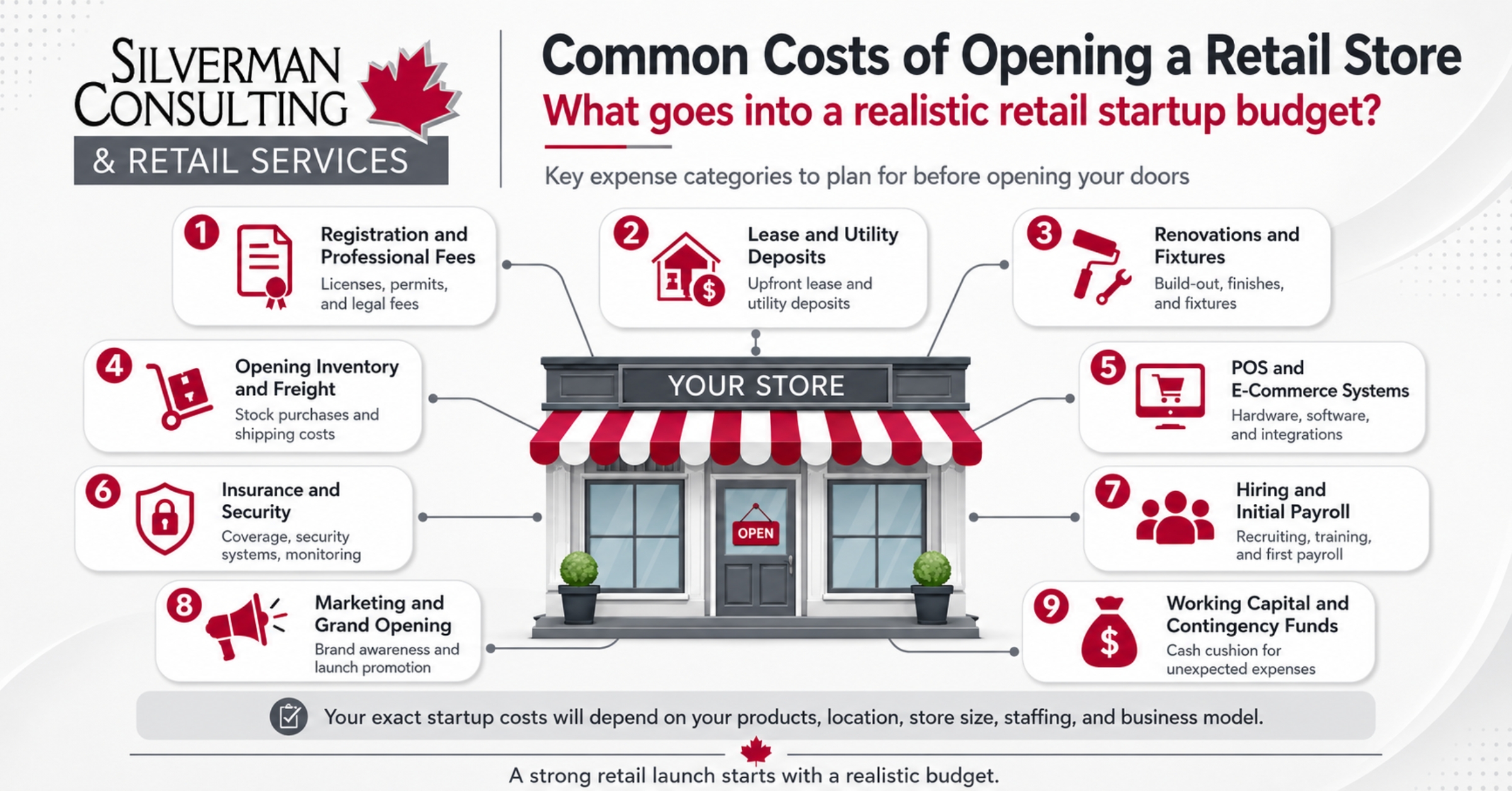
Depending on your business, your initial costs may include:
- Business registration and professional fees
- Lease deposits and utility deposits
- Renovations, fixtures, displays, and signage
- Opening inventory, freight, and applicable duties
- Point-of-sale and e-commerce systems
- Security equipment
- Insurance
- Recruitment, training, and initial payroll
- Grand-opening marketing
- Working capital and a contingency fund
Our guide to creating a retail store budget can help you think through these costs in more detail.
It’s also important to remember that sales, profit, and cash in the bank are not the same thing.
Inventory purchases, payment terms, seasonal demand, and operating expenses can create pressure even when sales appear strong.
Planning how you’ll manage retail cash flow before you open can help you prepare for slower periods and unexpected costs.
Register Your Business
This is the formal part: making sure your business is properly established and ready to operate.
The exact steps depend on your legal structure, where in Canada you plan to operate, and the products or services you intend to offer.
The registration itself may be straightforward, but choosing a name, deciding on a structure, setting up tax accounts, securing permits, and obtaining professional advice can take time.
Start well before your planned opening date.
You’ll need to make several important decisions.
Choose a Business Name
Your business name should be memorable, relevant to what you sell, and appropriate for the customers you want to reach.
It also needs to be available.
Before committing to a name, search the internet, domain names, and social media handles.
You should also search Canada’s business registries and the Canadian Trademarks Database for identical or confusingly similar names.
Depending on where you plan to operate, you may also need to search the relevant provincial or territorial trade-name registry.
A business-name search and a trademark search serve different purposes, so don’t rely on only one database.
If you plan to operate outside Canada, investigate the naming and trademark requirements in each relevant country as well.
Choose the Legal Structure of Your Business
Should you operate as a sole proprietorship, partnership, or corporation?
Each structure can affect your liability, taxes, administrative responsibilities, ability to raise money, and future plans.
Be sure to speak with a business lawyer, accountant, or other qualified professional before making this decision.
Complete the Required Registrations and Tax Accounts
Depending on your business, you may need to register a business name or corporation provincially or federally, obtain a business number, and open the appropriate Canada Revenue Agency program accounts.
The Government of Canada provides an overview of business registration, but an accountant or lawyer can help you determine what applies to your situation.
Obtain Any Licences and Permits You Need
The licences and permits you need can depend on your municipality, location, renovations, signage, products, and services.
Retailers selling food, alcohol, cannabis, pharmaceuticals, or other regulated products may face additional requirements.
Repair services and other specialized activities may also require specific credentials or approvals.
You can use BizPaL to search for federal, provincial or territorial, and municipal permits and licences that may apply to your business.
For example, anyone intending to operate food premises in Toronto must notify the Medical Officer of Health before opening.
Toronto food premises are also subject to provincial food-safety requirements and public-health inspections.
The City’s food-business guide explains these requirements in more detail.
Arrange Business Insurance
There are several types of business insurance you may want or be required to carry.
These may include:
- Commercial general liability insurance
- Commercial property insurance
- Commercial auto insurance
- Crime insurance
- Business interruption insurance
- Inventory and stock insurance
- Cyber insurance
Your insurance needs will depend on factors such as your lease, employees, inventory, vehicles, e-commerce operations, and the products you sell.
A commercial insurance broker can help you assess the risks that apply to your business.

Choose a Good Location
If you want a brick-and-mortar store, choosing the right location will be one of your most important decisions.
Before signing a lease, read our guide to choosing a retail store location.
Factors to consider include:
- Your target market
- Local demographics
- Zoning and permitted use
- Visibility and foot traffic
- Parking, public transit, and accessibility
- Nearby businesses and competitors
- Base rent and additional occupancy costs
- The condition of the space and required renovations
- Storage, deliveries, and inventory handling
- The needs of your employees
- Your budget
A high-traffic area can be valuable, but only if the people passing by are likely to become customers and the expected sales justify the cost.
A lower-traffic destination may work well for a specialized store that gives customers a strong reason to make the trip.
Have a lawyer review the lease, and confirm zoning, signage, renovation, and operating requirements before you commit.
Your physical location is only one part of your presence.
A useful website, accurate business listings, and a consistent online shopping or inquiry experience can increase your visibility and help customers decide whether to visit.
Plan Your Suppliers and Inventory
Reliable suppliers and a disciplined inventory strategy are essential to keeping the products your customers want in stock without tying up too much money.
When comparing suppliers, consider:
- Wholesale pricing and potential margins
- Minimum order quantities
- Shipping costs and lead times
- Payment terms
- Return policies
- Product quality and consistency
- Seasonal availability
- Whether backup suppliers are available
Your opening inventory should offer enough variety to make the store feel complete without forcing you to overinvest in products that haven’t yet proven themselves.
Once you begin selling, use real sales data to adjust quantities, identify slow-moving products, and plan reorders.
Our guide to retail inventory management explains how better tracking and planning can help reduce preventable inventory problems.

Choose Your Retail Technology
Your point-of-sale system can do much more than process payments.
Depending on the platform, it may also help you track inventory, manage customer information, monitor employee sales, produce reports, and connect your physical and online stores.
When choosing a POS system, compare the features you need, payment-processing costs, hardware expenses, contract terms, customer support, security, and integrations.
Set up and test your systems before opening so your team has time to learn them and you can correct problems before customers are waiting at the checkout.
Hire and Train the Right Employees
If you need employees, determine the roles, schedule, and experience required before you begin recruiting.
Be realistic about the full cost of staffing, including recruitment, training, payroll-related costs, and coverage for busy periods, illness, and vacations.
When you’re ready to hire, our article on finding retail employees can help you think through the process.
Training should cover more than the POS system.
Your employees should understand your products, customer-service standards, return policy, safety procedures, loss-prevention practices, and what to do when a problem needs to be escalated.
Build a Marketing Plan Before You Open
Don’t wait until opening day to begin telling people about your store.
Your marketing plan may include:
- A website and local business profiles
- Social media
- Email marketing
- Local advertising and public relations
- Community partnerships
- In-store signage and window displays
- Opening events or promotions
- A plan for requesting and responding to customer reviews
Make sure your branding and messaging give customers a clear reason to choose you.
Once customers begin visiting, focus not only on attracting new shoppers but also on encouraging repeat business.
It’s also wise to create a process for monitoring and maintaining your online reputation from the beginning.
Prepare for Opening and Measure What Happens Next
Before your full launch, consider holding a soft opening to test your systems, staffing, store layout, and customer experience.
Make sure:
- Products are priced and entered correctly
- Inventory counts are accurate
- Payment systems work
- Employees understand their responsibilities
- Return, exchange, privacy, and other store policies are ready
- Your website and business listings show accurate information
- Customers can easily understand where to go and how to buy
After opening, compare actual results with the assumptions in your business plan.
Track measures such as sales, gross margin, average transaction value, conversion rate, inventory sell-through, operating expenses, cash flow, and repeat purchases.
Your original plan is a starting point.
Use what you learn to refine your product mix, staffing, marketing, and operations over time.
Plan for Every Stage of Your Retail Business
Starting a retail business can be exciting, but lasting success requires much more than choosing products and opening your doors.
By selecting a focused niche, understanding your customers and competitors, building a realistic financial plan, and preparing your operations carefully, you can create a stronger foundation for the future.
Just as importantly, developing a retail business exit strategy early can help you protect the value you build and prepare for a future sale, relocation, retirement, or closure.
At Silverman Consulting and Retail Services, we help retailers navigate these major transitions and make informed decisions at every stage of the business lifecycle.
Book your consultation today and let us help you prepare for every stage of your retail journey.
Silverman Consulting & Retail Services229 Yonge St suite 400,
Toronto, ON M5B 1N9, Canada
1 (888) 955-1069